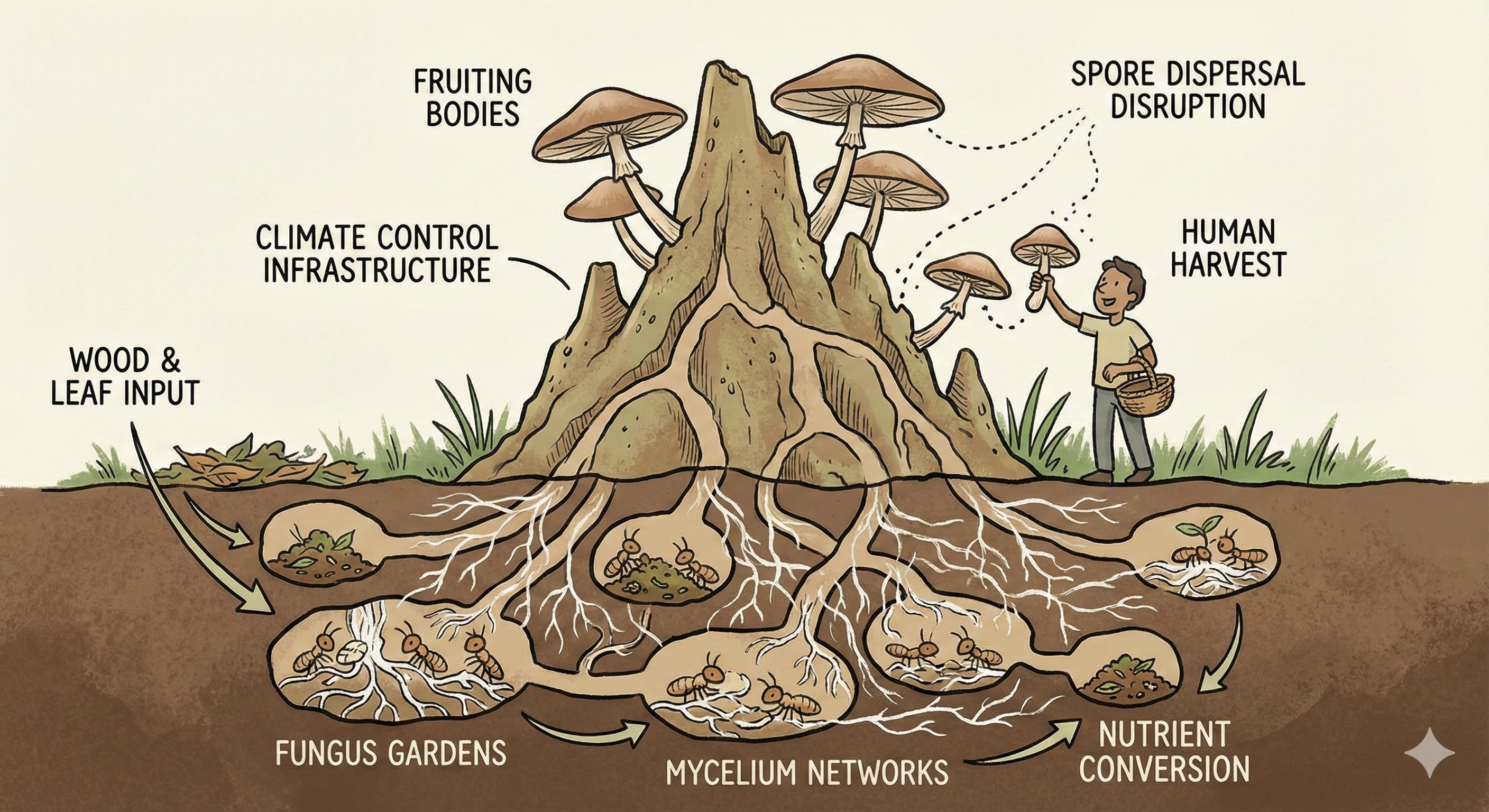
Termites Do Not Cultivate Mushrooms – They Cultivate Durability

We tend to call only surface societies “civilizations.”
Yet beneath our feet, another kind of state exists.
A city with a king and a queen, workers and soldiers, farms and logistics networks-
and architecture refined enough to regulate climate.
A termite mound is not merely a “home.”
It is an underground civilization sustained by fungal agriculture.
Humans believe they are simply lucky when they harvest rare mushrooms.
But from another perspective, the story sounds different:
not “I found a precious mushroom,”
but “I raided someone else’s farm.”
The seasonal frenzy around termite mushrooms is a brief collision-
between a small, ancient city-state and human raiders.
This article is not about how delicious those mushrooms are.
What truly matters lies deeper.
The termite–mycelium system is not primarily a device for food production.
It is a technology of storage, transformation, and long-term survival-
and it offers a crucial hint for an era of climate instability and fragile supply chains.

1. The Termite City Garden: Storage Through Transformation, Not Harvest
Fungus-farming termites do not simply gather food.
They collect dead wood, fallen leaves, and plant fibers-resources that are hard to digest and quick to rot-
and process them into fungus gardens (fungus combs).
In these gardens, mycelium breaks down rigid plant matter
and converts it into stable nutrition that can endure time.
- Input: Wood, leaves, plant waste (unstable resources that are difficult to store)
- Process: Termite logistics + mycelial decomposition and fermentation
- Output: Nutritional structures that can be consumed gradually and reliably
This is not agriculture in the conventional sense.
It is biological storage through transformation.
The system prioritizes conversion over accumulation-
not “stack it,” but “change it into something that lasts.”

2. Termite Mounds Are Climate-Controlled Infrastructure, Not Homes
A termite mound is less a residence than a facility.
Mycelium-based agriculture collapses if temperature, humidity, or gas exchange becomes unstable.
As a result, termite architecture performs multiple functions at once:
- Climate regulation (temperature and humidity control)
- Ventilation (oxygen–carbon dioxide balance)
- Contamination management (suppression of harmful fungi)
- Defense and security
- Internal logistics and circulation
In modern terms, a termite mound resembles a climate-controlled bio-storage facility-
combined with a decentralized refinery and a security system.
Its purpose is simple:
to preserve the conditions in which food can remain food.
3. What Humans Harvest Is Not Food—It Is a Signal
The mushrooms humans prize-the caps and stems emerging from the soil-
are not the termites’ primary food source.
They are fruiting bodies, released only when the underground system is stable
and environmental conditions align.
Biologically, this means:
not “food is available,” but
“the storage-and-conversion system is functioning well.”
To termites, the mushroom is an output signal of system health.
To humans, it becomes a luxury commodity.
The same object-read through two radically different logics.
4. Human Raiding Is Not About Food, but About the Future
Calling humans “thieves” is not a moral judgment; it is a structural description.
Harvesting mushrooms alone does not necessarily starve termite colonies.
Their true reserves remain underground.
However:
- Excessive harvesting reduces spore dispersal
- Long-term regeneration patterns may weaken
- And when humans dig aggressively, they destroy the climate infrastructure itself
At that point, the loss is no longer seasonal.
It becomes systemic.
What is stolen is not a meal, but resilience–
the accumulated stability of a living system.
5. Why This Is a Model for Future Storage Systems
The termite–mycelium system directly addresses the challenges modern societies now face:
- Climate volatility
- Supply chain collapse
- Energy-intensive storage
- Resource waste
Instead of centralized stockpiles, termites rely on distributed, low-energy, regenerative storage
embedded directly into living infrastructure.
Each mound is autonomous.
Each garden local.
Each system resilient.
This is not a growth-oriented civilization.
It is a continuity-oriented civilization.
Conclusion: Termites Do Not Farm Mushrooms—They Farm Durability
Termite mushrooms may fascinate us as food.
But their true significance lies in structure.
Beneath the ground exists an agricultural city-state
whose core achievement is not abundance, but endurance.
Termites do not cultivate mushrooms.
They cultivate a way of storing the future.
Leave a Reply