최근에 배운 기술 또는 교훈은 무엇인가요?
I never knew how hard it would be for a writer to imitate a developer.
But what surprised me even more was this: inside that “imitation,” I ended up seeing—again—what kind of person I truly am.
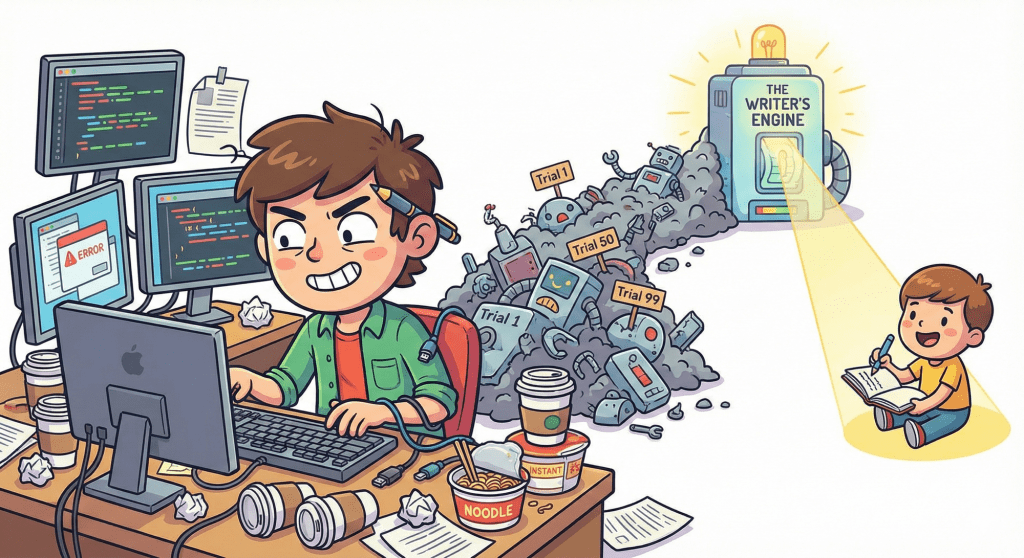
When I trained the model, I repeated the process hundreds of times.
When I tested decoder tuning, I ran it more than a hundred times.
Mapper tuning—about a hundred trials, too.
And when I built the rules for LLM auditing, I tested them at least a hundred times.
I didn’t eat. I didn’t wash. I didn’t sleep.
I was consumed by testing.
GPT wrote the code, but I did the testing.
No matter how brilliant an AI is, it cannot write perfect code in a single attempt.
Because code isn’t a sentence—
it lives and moves on top of environment and reality.
Recently, I learned one more skill:
cloud deployment and SaaS migration.
I fought that battle a hundred times as well.
I repeated the attempt until it worked—again and again—
and in the end, I finished deploying a service that runs even on a smartphone.
For something I built at the beginning, it’s surprisingly stable.
And that stability isn’t talent.
It’s the result of repetition—of refusing to let go until it held.
But at this point, I had to admit one uncomfortable truth.
I am not a successful writer.
When I wrote, I wasn’t this stubborn, this obsessive, this relentless.
So I never became a great writer.
Instead, I built a tool that can help someone become one.
Maybe this is my way.
Not the person who leaves behind one perfect masterpiece,
but the person who builds a device—
a mechanism that keeps someone writing to the end,
that stops them from collapsing,
that makes them rewrite, again and again.
And that device—
only after a hundred failures—
finally began to work.


Leave a comment