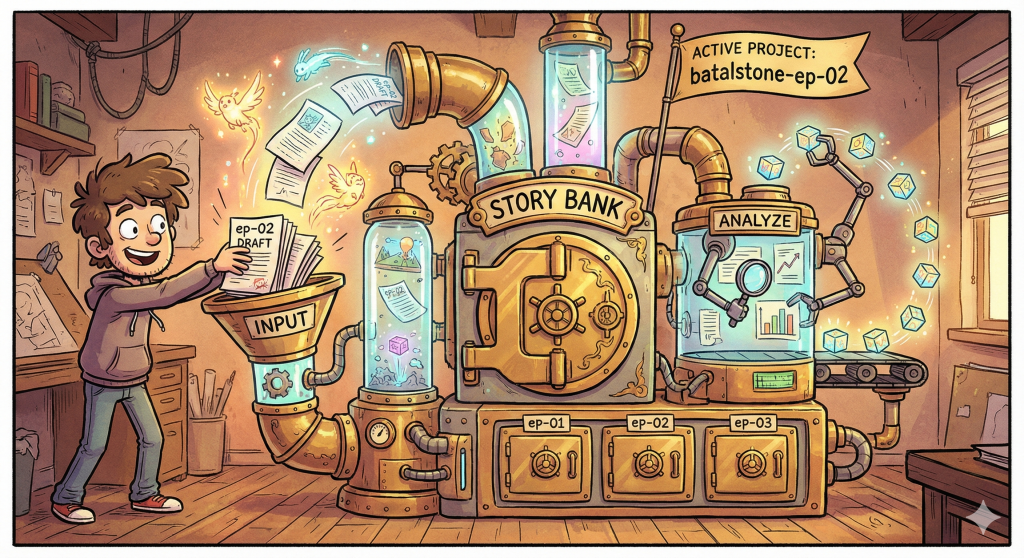
Story Bank: 이야기를 저장하는 게 아니라, 다시 살아나게 하는 금고
Story Bank: Not a vault that stores stories, but a vault that brings them back to life어떤 날은, 내가 쓴 장면이 내 손에서 빠져나와 어디론가 흩어진 것처럼 느껴진다.
파일은 남아 있는데, 맥락이 사라진다. 감정의 온도는 식고, “왜 이 장면을 썼는지”가 흐릿해진다.
그래서 나는 Story Bank를 만들었다.
Some days, the scenes I wrote feel like they slipped out of my hands and scattered somewhere unseen.
The files remain, but the context dissolves. The temperature of emotion cools, and “why I wrote this scene” turns faint.
So I built Story Bank.
이건 ‘정리’가 아니라 ‘회수’다. 회수란, 파일이 아니라 맥락(왜 썼는지)을 되찾는 일이다.
It’s not “organizing.” It’s recovery—reclaiming not the file, but the context (why it was written).
한눈에 보는 Story Bank · At a glance
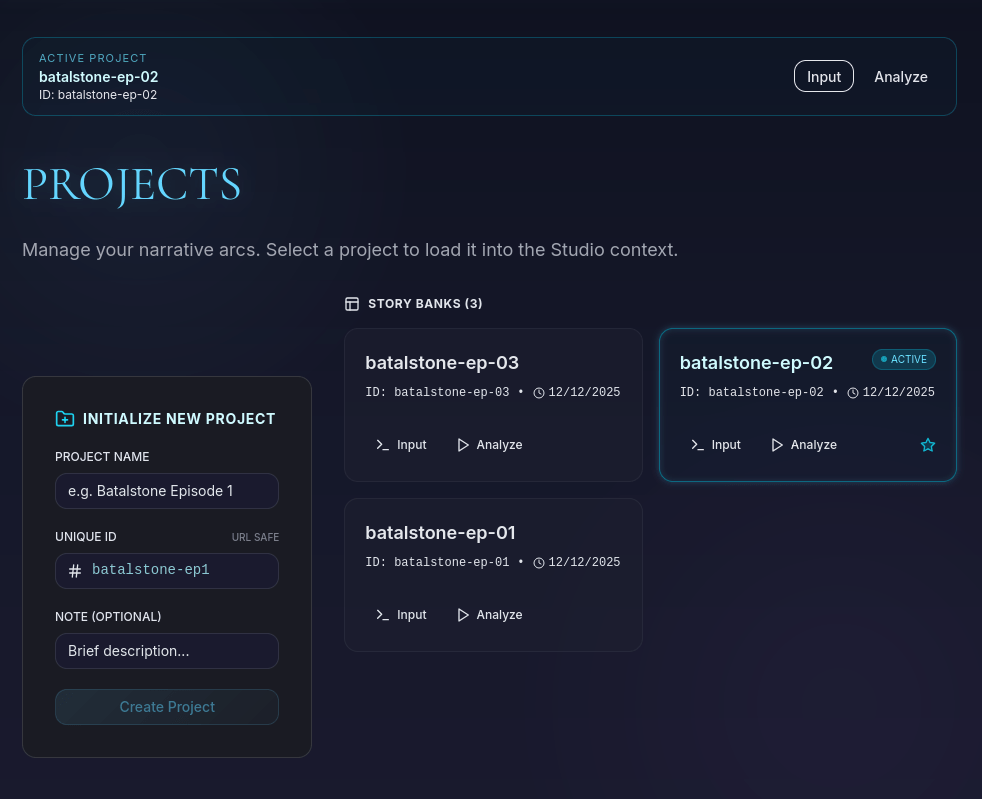
ACTIVE PROJECT:
지금 숨 쉬는 세계를 화면 위에 고정한다 — batalstone-ep-02
ACTIVE PROJECT: pins the world you’re breathing in right now — batalstone-ep-02
STORY BANKS (3):
ep-01, ep-02, ep-03 — 에피소드가 늘어날수록, 돌아갈 수 있는 문이 늘어난다
STORY BANKS (3): ep-01, ep-02, ep-03 — as episodes grow, so do the doors you can return to
Input:
오늘의 원고를 입금한다
Input: deposit today’s draft
Analyze:
넣어둔 이야기에서 리듬과 결함과 가능성의 단서를 꺼내 본다
Analyze: pull out clues—of rhythm, flaws, and possibility—from what you’ve deposited
오늘은 Input, 내일은 Analyze. 그리고 다시 Input.
Today: Input. Tomorrow: Analyze. Then Input again.
세 가지 작은 약속 · Three small promises
1) 내가 어디에 있는지 잃지 않게 한다
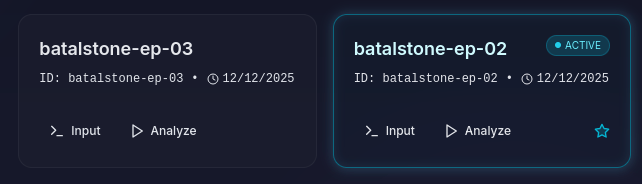
Active 뱃지는, 지금 작업 중인 세계를 고정해준다. 창작에서 길을 잃는 순간은 보통 ‘파일’이 아니라 ‘컨텍스트’를 잃을 때 온다.
1) Don’t lose where you are
The Active badge pins the world you’re working in. When writers lose their way, it’s rarely the file—it’s the context.
2) 반복 가능한 루프를 만든다: Input → Analyze → Input
한 번 쓰고 끝내는 게 아니라, 분석으로 얻은 힌트를 다시 입력으로 환원한다. 이렇게 하면 “감”이 “구조”를 밀어주고, 구조가 다시 감정을 지지하게 만든다.
2) Build a repeatable loop: Input → Analyze → Input
Not “write once and leave,” but return what analysis reveals back into the next input. Intuition pushes structure—and structure supports emotion.
3) 인터페이스는 ‘대화의 마침표’를 제공해야 한다
좋은 UI는 피드백을 주고, 한 덩어리의 행동이 끝났다는 마침(closure)을 제공한다. 그래서 Story Bank는 ‘Active’ 표시와 카드 액션을 분명하게 둔다.
3) An interface should give closure
A good UI offers feedback and signals closure. That’s why Story Bank keeps the “Active” marker and card actions clear.
이 설계가 닮아 있는 것 · What this resembles
이 구조는 콘텐츠 전략 분야에서 자주 쓰이는 “content inventory → content audit”의 흐름과 닮아 있다.
즉, 가진 것을 목록화하고(inventory), 그 목록의 품질과 공백을 점검해(audit) 다음 행동을 정한다.
This mirrors a common content strategy flow: “content inventory → content audit.”
First list what exists, then evaluate quality and gaps to decide the next actions.
다음 버전에서의 목표 · Next version aims
Story Bank가 단순한 목록을 넘어, 연결을 만들도록.
프로젝트들은 상징/감정 태그로 서로를 알아보게 하고, 분석 결과는 스냅샷으로 쌓아 “성장 기록”이 되게 한다.
To become more than a list—to become connection.
Projects recognize each other through symbol/emotion tags, and analysis stacks into snapshots—forming a record of growth.
플롯을 설계하는 방식은 사람마다 다르지만, “구조를 의식하는 글쓰기”가 작동하는 예시는 많다.
예를 들어 Brandon Sanderson은 공개 강의 자료에서 플롯을 Promise–Progress–Payoff 같은 구성으로 분해해 설명하고, 자신의 아웃라이닝 방식(‘floating outline’)을 소개한다.
Plotting differs for every writer, yet structure-aware writing has many working examples.
For instance, Brandon Sanderson breaks plot into frames like Promise–Progress–Payoff and describes his “floating outline.”
너의 이야기는, 저장될수록 더 선명해진다.
The more you store, the clearer your story becomes.
참고 · References
- NN/g — Content Inventory and Auditing 101 — https://www.nngroup.com/articles/content-audits/
- Ben Shneiderman — The Eight Golden Rules of Interface Design — https://www.cs.umd.edu/users/ben/goldenrules.html
- Brandon Sanderson — 2025 Guide to Plot (Lecture #2) — https://www.brandonsanderson.com/blogs/blog/brandon-sandersons-2025-guide-to-plot-lecture-2



Leave a comment