
The Three Heavenly Seals and the Three Sacred Artifacts of the Batal stone Series
The “Three Heavenly Seals” (천부삼인, Cheonbu-Samin) are three sacred artifacts of profound significance in Korean ancient mythology and history. They symbolize divine authority from the heavens and play a central role in foundational myths, such as the legend of Dangun. The Batal stone series reimagines these traditional symbols with modern creativity, introducing three original sacred artifacts—Myeong-du, Pal-ju-reong, and Shin-geom—to weave a compelling narrative. This article explores the historical and symbolic background of the Three Heavenly Seals and examines the roles and meanings of the sacred artifacts in the Batal stone series.
Historical Background
According to the myth of Dangun, the Heavenly God Hwanin bestowed the Three Heavenly Seals upon his son Hwanung to grant him the authority to rule the mortal realm. These sacred artifacts symbolized divine blessing and the legitimacy of leadership, and they are linked to Korea’s Bronze Age culture.
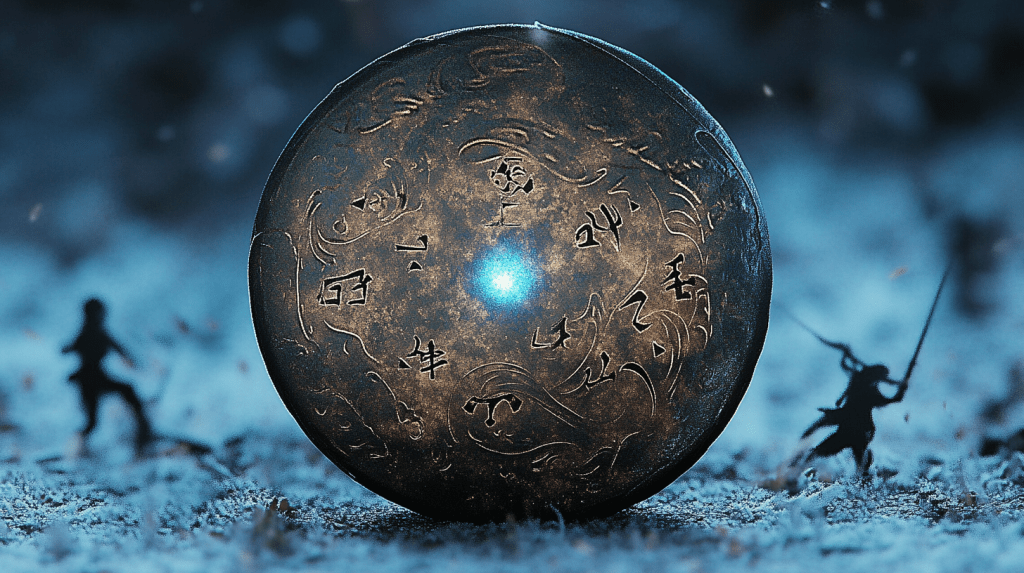
- Bronze Mirrors: Representing light and truth.
- Bells: Tools for communication between gods and humans.
- Swords: Symbols of order and the power to vanquish chaos.
Symbolic Meaning of the Three Heavenly Seals
The Three Heavenly Seals are often interpreted as representing Heaven (天), Earth (地), and Humanity (人), which correspond to the shapes of a circle (○), a square (□), and a triangle (△). This triadic symbolism reflects the harmony between humanity, nature, and the cosmos, encapsulating the philosophical worldview of ancient Koreans.
Their significance is also intertwined with ancient Korean texts such as Cheon-bu-gyeong, Sam-il-sin-go, and Cham-jeon-gyeong, where they embody cosmological and ethical principles. The Three Heavenly Seals were central to Korea’s ancient culture and religion, signifying the divine authority and sanctity of rulers.

The Three Sacred Artifacts in the Batal stone Series
In the Batal stone series, the traditional elements of the Three Heavenly Seals are reinterpreted in a modern context through the introduction of three unique artifacts: Myeong-du, Pal-ju-reong, and Shin-geom. Each artifact possesses distinct powers and symbolism, contributing significantly to the narrative.
- Myeong-du (명두)
- Role: A sacred artifact capable of pacifying the rampaging Batals.
- Symbolism: Beyond its technical function, Myeong-du symbolizes the protagonist’s realization of their greater responsibility to unite two warring factions. It marks a pivotal turning point in the story.
- Pal-ju-reong (팔주령)
- Role: A bell that amplifies the power of Myeong-du through its resonant frequencies.
- Symbolism: The interdependence of Paljureong and Myeong-du illustrates the importance of unity and solidarity among allies. The scene where these artifacts combine to subdue the Batals emphasizes the theme of camaraderie and collective strength.
- Shin-geom (신검)
- Role: A transformative artifact that redefines the powers of the other two and embodies neutrality.
- Symbolism: The Shin-geom represents the protagonist’s acceptance of justice and their destiny, encapsulating a symbolic moment of growth and self-realization.

Similar Artifacts in Other Cultures: Japan’s Three Sacred Treasures
Comparable to Korea’s Three Heavenly Seals are Japan’s Three Sacred Treasures (三種神器, Sanshu no Jingi), which symbolize the authority of the Japanese emperor. These treasures include:
- Mirror (Yata no Kagami): Symbolizing truth and wisdom.
- Sword (Kusanagi no Tsurugi): Representing courage and military power.
- Jewel (Magatama): Denoting unity and harmony.
The Three Sacred Treasures were passed down from the Sun Goddess Amaterasu to her descendants, symbolizing divine favor and imperial legitimacy. Like the Three Heavenly Seals, they reflect a cosmological balance and the divine right of rulers. However, their emphasis leans more heavily on centralizing power, highlighting a difference in cultural and social contexts between the two traditions.
The Three Heavenly Seals symbolize the cosmic harmony of heaven, earth, and humanity, emphasizing unity and divine authority. The Batal stone series modernizes these symbols through its inventive sacred artifacts—Myeong-du, Pal-ju-reong, and Shin-geom—using them to explore themes of growth, unity, and transformation. The series bridges traditional mythology and contemporary storytelling, offering readers a creative and immersive narrative that celebrates cultural heritage while reimagining its relevance in a modern context.



Leave a comment