The Batal Tree in Batal Stone and Mythological Trees: A Modern Interpretation of Ancient Symbols

“Hey, look over there!”
All eyes turned to Panum’s wooden staff. Incredibly, new sprouts were emerging from the once-dead wood. Everyone’s mouths fell open.
The sprouts quickly grew into leaves, and the thin stick thickened until it was too large to wrap their arms around. Like a time-lapse of a tree growing, the staff transformed into a grand tree, providing shade for the Komi people. Barun, now acting like a child, approached Panum excitedly.
“Is this magic?”
“Yes, you could call it that.”
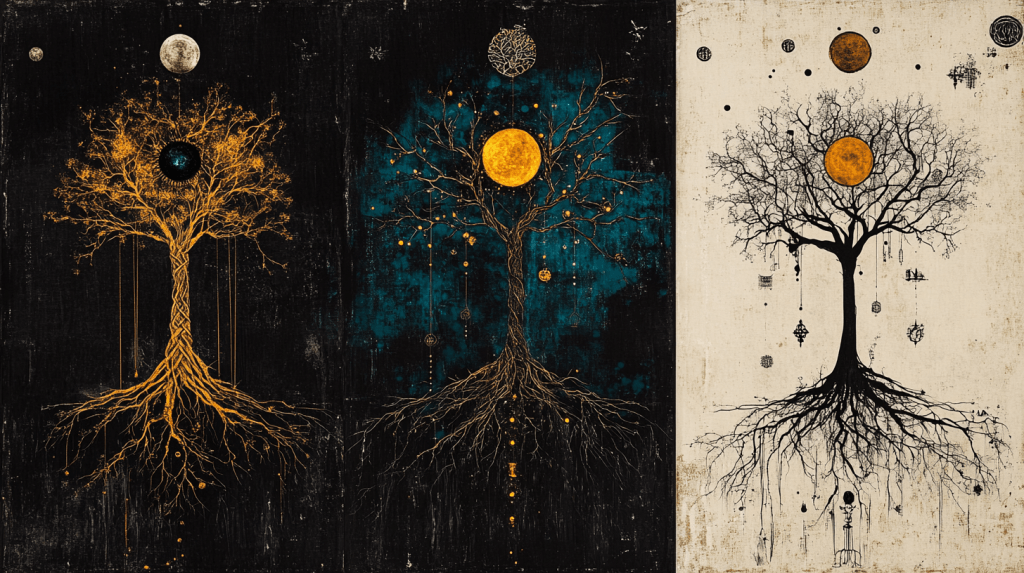
In the narrative of Batal Stone, the Batal Tree is not just a clue-bearing object for the future hero. It serves as a symbolic bridge connecting ancient and modern times, myth and reality, while bearing striking similarities to sacred trees in myths across cultures. Most notably, it draws a deep connection to Korea’s Sacred Tree (Shindan-su), under which Hwanung laid the foundation of the divine city of Sinsi. The Sacred Tree, a key symbol linking heaven and humanity, mirrors the Batal Tree’s crucial role as a mediator between the divine and the mortal.
Just as the Shindan-su unified existence under its shade, the Batal Tree functions as a unifying medium, holding the strength and clues necessary for the future hero. Understanding and protecting this tree marks a pivotal moment in the story’s progression.
Comparisons with Other Mythological Sacred Trees
The important role of trees in myths is not unique to Korean culture. For instance, Norse mythology introduces Yggdrasil, the World Tree, which connects all dimensions of existence, symbolizing life, wisdom, and cosmic order. Like Yggdrasil, the Batal Tree in Batal Stone anchors the narrative, connecting worlds and beings while holding vital power and wisdom.
In Chinese mythology, the Jianmu Tree is depicted as a sacred tree linking the heavens and the earth, serving as a bridge for communication between gods and humans. Similarly, the Batal Tree serves as a medium of divine power, passed down to the chosen hero to save the world. Both trees symbolize hope and salvation in their respective stories.In Mayan mythology, the Ceiba Tree is revered as the World Tree, connecting the heavens, earth, and the underworld. It symbolizes cosmic harmony and vitality, much like the Batal Tree, which represents the possibility that everyone can become a hero. The Batal Tree inspires hope, awakening the latent heroism within individuals, similar to the Ceiba’s cosmic significance.
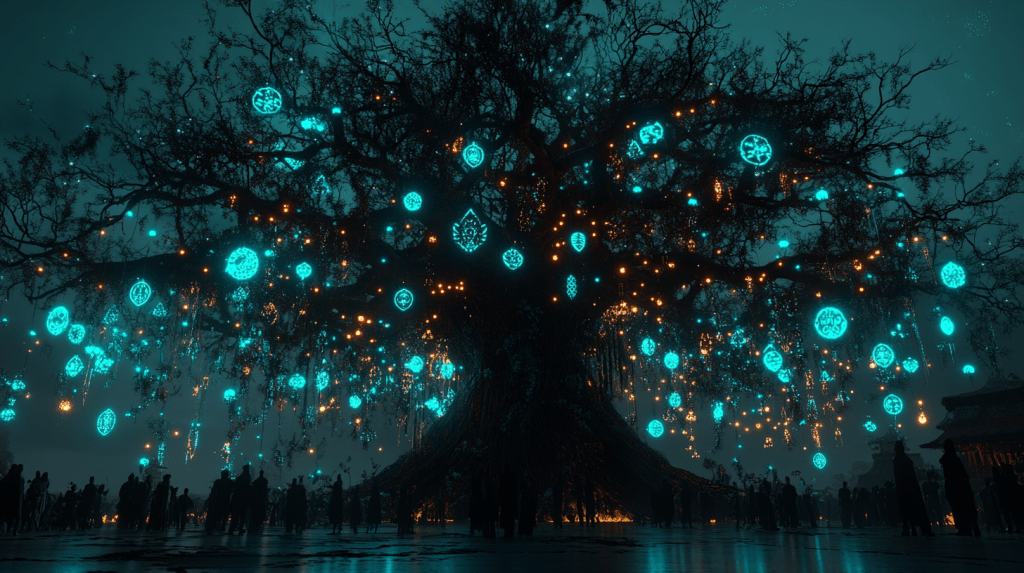
Panum reached out to the tree trunk. A faint light began to emanate from his hand, creating symbols as it flowed. Barun, watching in awe, asked.
“The light looks strange. It seems like a picture or dots.”
“It’s not just light; these are called letters.”
“Letters? What are those?”
“A tool to convey thoughts without speaking.”
Impossible. To convey thoughts without speaking? Though body language existed, it was done physically. Shocked, Barun exclaimed.
“Really, without speaking?”
“Yes. That’s why you must protect this. All of you.”
As Panum exerted force with his hand, the symbols of light were absorbed into the tree trunk.
Symbolism and Narrative Significance of the Batal Tree
The Batal Tree transcends its role as a narrative device, symbolizing both humble heroism and human potential. Much like the Bakdal Tree(oak tree) in Korean culture deeply supports everyday life, the Batal Tree serves as a symbol that anyone can rise to heroism. The luminous characters engraved on the Batal Tree hold the key to saving the world and represent the trials and growth essential to the hero’s journey.
The story of the Batal Tree reinterprets the symbolic meaning of sacred trees from ancient myths into a modern narrative. The concept of the Sacred Tree originating from the Shindan-su connects with the sacred trees of various cultures, symbolizing the potential for everyone to be a hero.This theme ties directly to the core message of Batal Stone: every individual possesses latent heroic qualities, and discovering and nurturing those qualities defines the true journey of a hero. Through this, the Batal Tree becomes a symbol of unity, resilience, and humanity’s boundless potential.
“What is the name of this tree, Panum?”
The deputy chieftain, who had come over, asked. Phanum looked at him. The deputy chieftain scratched his head with an embarrassed smile.
“I don’t know. I just picked it up that day…”
Panum’s unexpected answer left the deputy speechless. Then Barun suggested.
“How about calling it the Batal Tree? Since it’s meant for Batal.”
“That’s a good idea. It’s fitting since it’s for Batal.”
Barun beamed at Panum’s praise.
“Let’s save the future together, Barun. I’ll protect you in return.”


Leave a comment